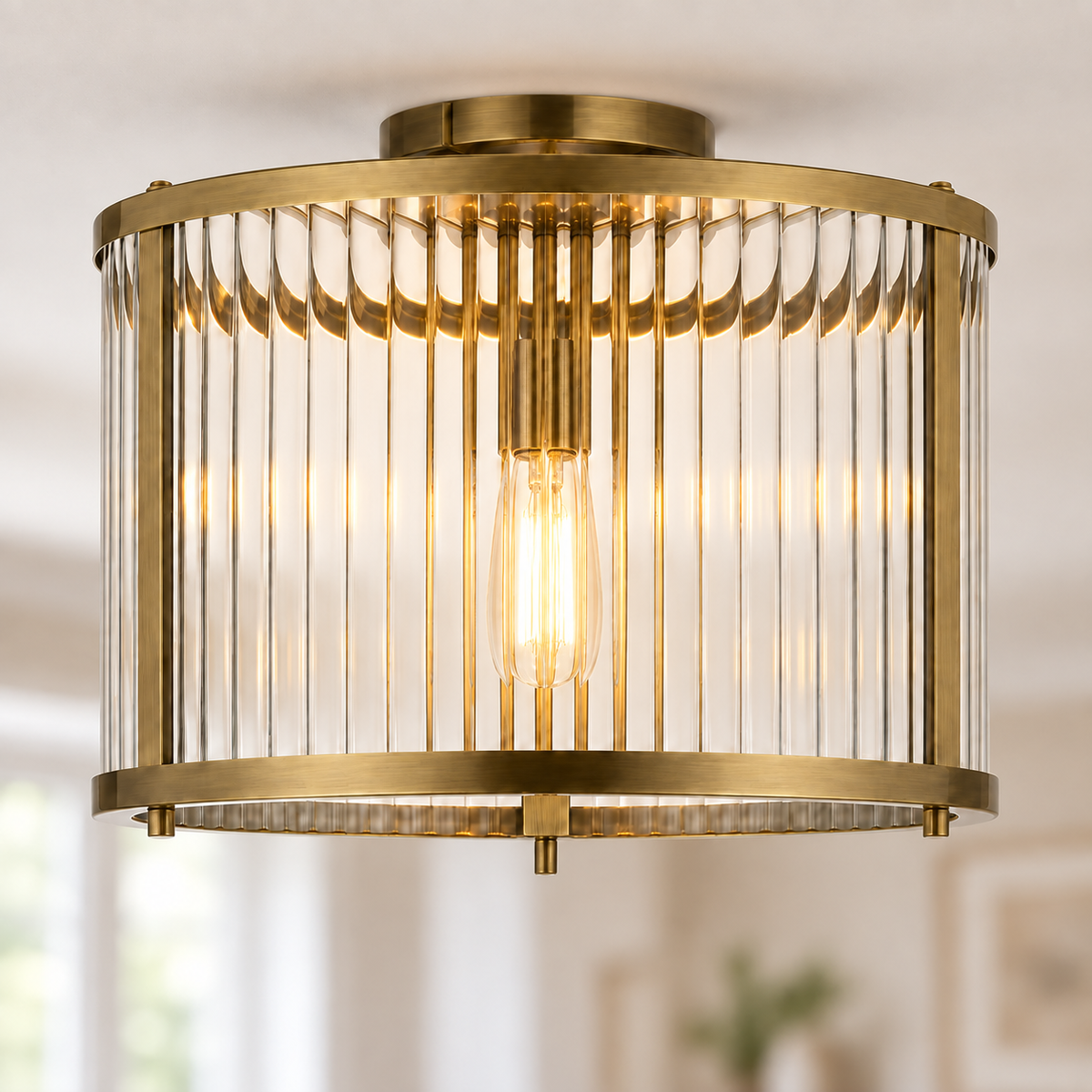
Most British homes have ceilings around 240 cm, and in a hallway, a bedroom or a landing that is not enough height for a pendant you can walk under. A flush or semi-flush light keeps the decorative glass and brass, sits within the top 20 to 30 cm of the room, and leaves the space beneath it clear.
Flush or pendant?
| Ceiling height | Where people walk under it | Over a table or island |
|---|---|---|
| Under 230 cm | Flush only | Short pendant, or flush |
| 230–250 cm | Flush or semi-flush | Pendant |
| Over 250 cm | Either; a pendant fills the height better | Pendant |
The test is simple: you want at least 200 cm, ideally 210 cm, between the floor and the lowest point of any light that people walk beneath. Take the fitting's height from your ceiling height and see what is left. Our Halo flush light is 21.5 cm deep and Rivoli is 26 cm, so both clear 210 cm under a 240 cm ceiling.
How wide should it be?
A useful starting point is to add the room's length and width in metres and allow roughly 8 cm of fitting for every metre. A 3 × 3 m bedroom comes out at about 48 cm; a 1 × 4 m hallway at about 40 cm. Treat it as a guide to the amount of light fitting the room wants, not a rule for one fitting:
- Long hallways look better with two or three smaller lights, spaced evenly, than one large one. A 25 to 31 cm fitting every 2 to 2.5 m is about right.
- Small rooms such as cloakrooms and box rooms suit a single 25 cm light.
- Living rooms rarely rely on the ceiling light alone. Size it for presence, then add wall lights or lamps for the evening.
Bathrooms and IP ratings
Most decorative lights are rated IP20, which means dry rooms only. In a bathroom the regulations divide the space into zones: directly above a bath or shower up to 225 cm from the floor is zone 1, and the 60 cm band around it is zone 2. Both need a fitting rated at least IP44, which means protected against splashing water.
Rivoli is our IP44 ceiling light. It can be used in zones 1 and 2 of a bathroom as well as in hallways, bedrooms and kitchens. Bathroom circuits have their own rules on protection and switching, so always use a qualified electrician.
Getting the light right
A flush light is usually the main light in the room, so it has more work to do than a pendant over a table. Clear ribbed glass helps, because it throws light sideways across the ceiling as well as down. Use a warm white (2700 K) dimmable LED at the maximum wattage shown on the product page, and put it on a trailing-edge LED dimmer so that the same fitting can be bright for cleaning and soft for the evening.
Matching the rest of the room
The Halo flush light shares its ribbed glass and antique brass with the Halo pendants and wall lights, so a flush light in the hallway, a pendant over the dining table and a pair of wall lights by the fireplace can all carry the same finish.


