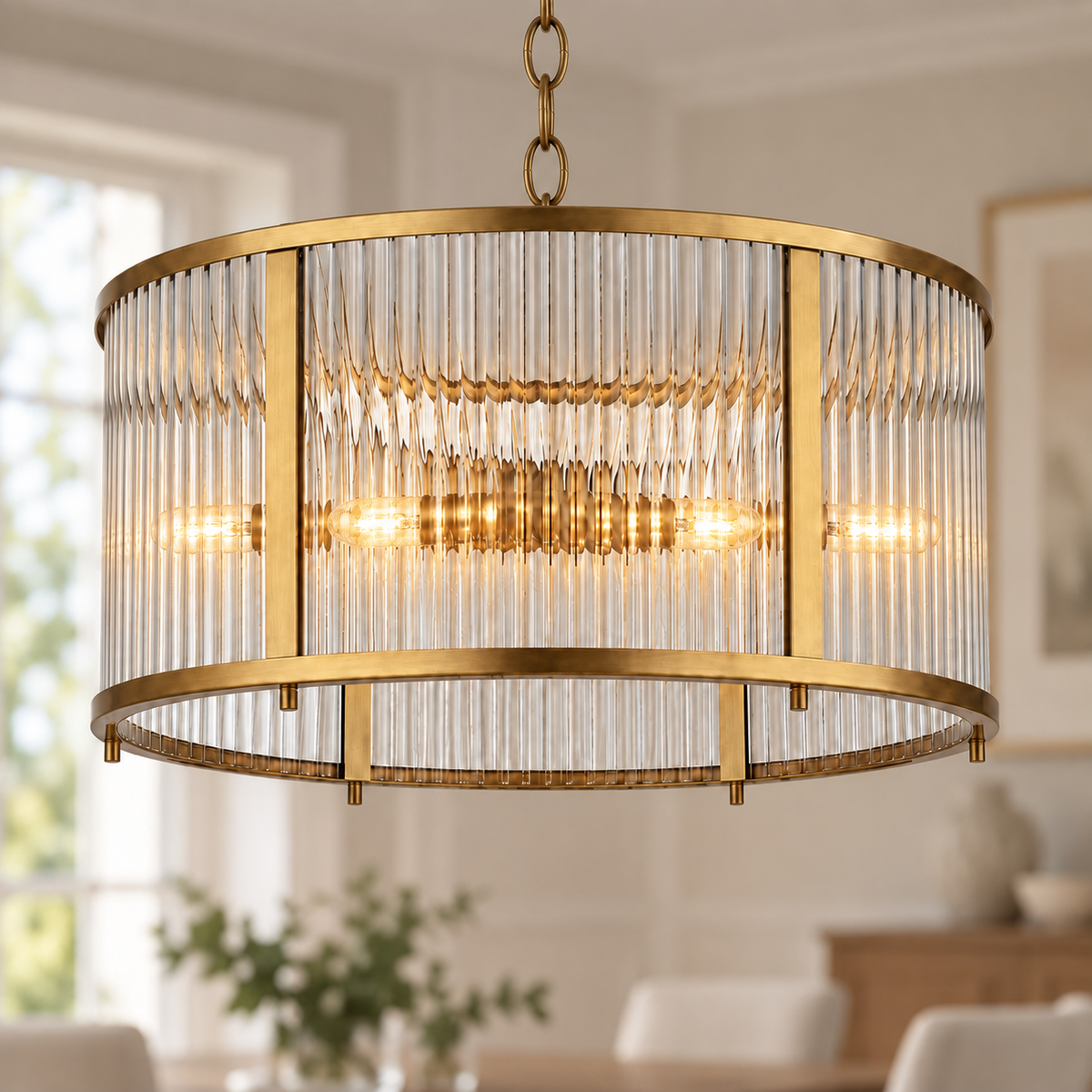
A clear or ribbed glass pendant does a different job from a coloured shade. It does not tint the room; it gives the light a shape. The fluting breaks the glow into fine vertical lines, the brass frame draws an outline, and because you can see through it, even a large fitting never blocks the view across a room. That makes size and hanging height the two decisions that matter most.
What size pendant?
| Where | Pendant width | From our range |
|---|---|---|
| Hallway, landing, bedside, or grouped in twos and threes over an island | About 20 cm | Halo Petite, Solene |
| Bedroom or entrance hall centrepiece | 35–45 cm | Veyra 3-light, Halo 3-light |
| Round or square dining table up to 120 cm | 45–50 cm | Halo 3-light, Halo 5-light |
| Six-seat rectangular table or a kitchen island | About 90 cm long | Halo 4-light linear |
| Stairwell or a ceiling over 270 cm | 50 cm and a long drop | Halo 5-light |
Over a table, a pendant between half and two-thirds of the table's width looks right. Narrower than half looks lost; wider than the table means someone will eventually stand up into it. A linear pendant should stop at least 15 cm short of each end of the table or island.
Hanging height
Over a dining table or island, set the bottom of the fitting 70 to 80 cm above the surface. That keeps it out of the sightline between people sitting opposite each other while holding the light low enough to feel intimate.
Anywhere people walk underneath, such as a hallway, landing or the middle of a living room, leave at least 200 cm, and ideally 210 cm, between the floor and the lowest point of the fitting. With a standard 240 cm ceiling that leaves only 30 to 40 cm for the whole light, which is why a flush ceiling light is usually the better choice in a low hallway.
Check the drop both ways. Every pendant page lists a maximum drop, and chain and cable fittings are shortened by your electrician when the light is installed. Measure ceiling to floor, subtract the clearance you need, and make sure what is left is more than the height of the fitting itself.
One long pendant, or several small ones?
Three small pendants in a row is the familiar look over an island, and it works well with a 20 cm fitting spaced 60 to 75 cm apart, centre to centre. It does need three ceiling points, or a multi-outlet ceiling plate. A single linear pendant gives the same spread of light from one ceiling point and one switch line, and reads as one calm shape rather than three. If your wiring is already in place, let that decide.
Bulbs make more difference than usual
With clear glass the bulb is part of the design. Use a warm white (2700 K) LED filament bulb rather than a plain frosted one, and keep to the maximum wattage on the product page. Ribbed glass softens glare, but a multi-light pendant on full power over a dining table is still bright, so choose dimmable bulbs and fit a trailing-edge LED dimmer. Each product page tells you the cap type: most single pendants take E27, the multi-light drums take E14 candle bulbs.
Fixing and weight
The larger pendants weigh 5 to 6 kg. That is comfortably within what a ceiling joist or a properly fitted noggin will carry, but not a plasterboard fixing alone. All of our pendants are hardwired and should be installed by a qualified electrician, who will check the fixing at the same time.


