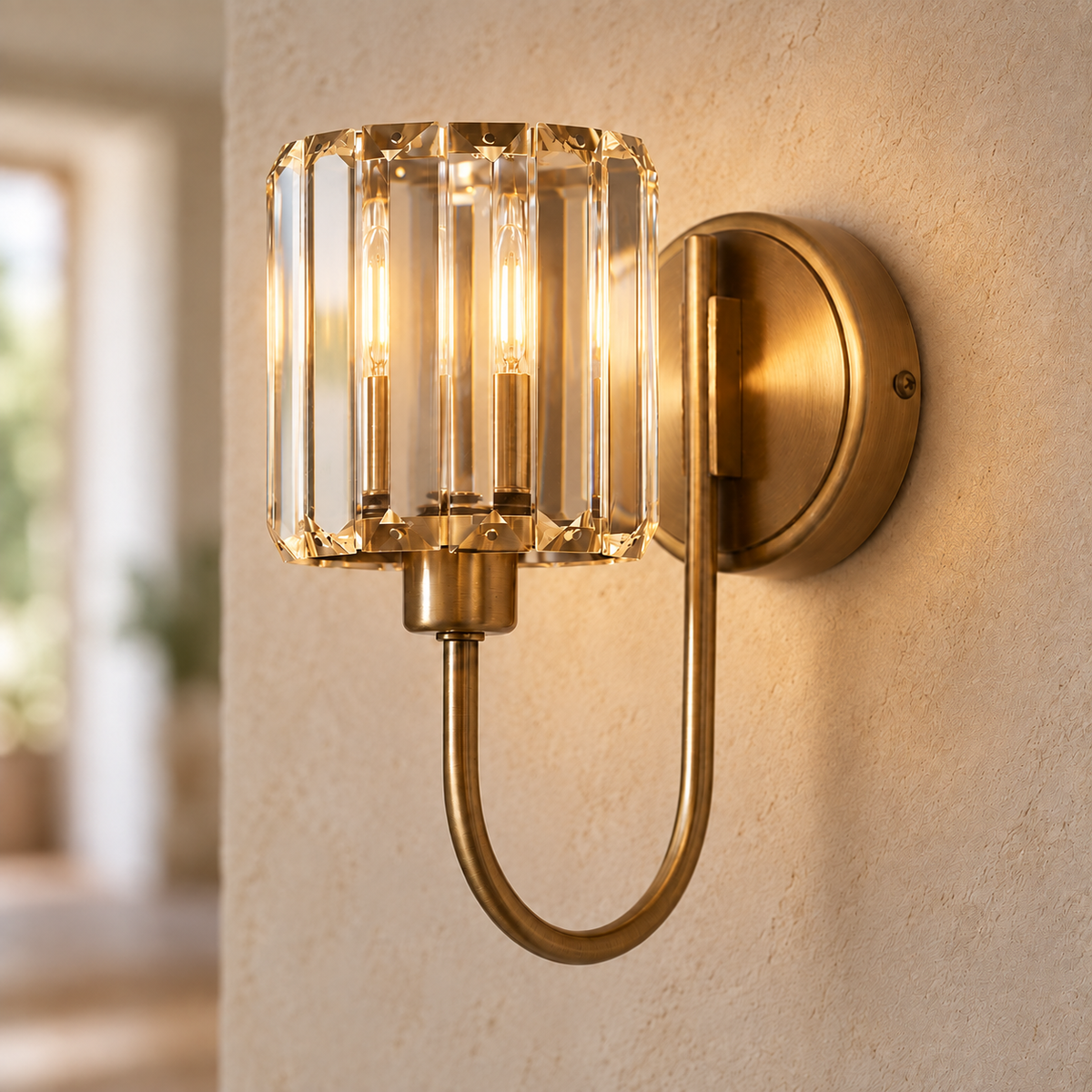
Wall lights are the part of a lighting scheme that makes a room feel finished. They put light at eye level, where a ceiling fitting cannot, and a pair of them brings symmetry to a mirror, a bed or a chimney breast. They are also the hardest lights to move afterwards, because the cable is buried in the wall, so it pays to settle the measurements before the electrician arrives.
The measurements
| Position | Height to the centre of the light | Spacing |
|---|---|---|
| Hallway or landing | 150–170 cm from the floor | Every 180–250 cm along the wall |
| Either side of a mirror | 150–165 cm, about eye level | 5–10 cm out from the mirror's edge |
| Either side of a fireplace or artwork | 150–170 cm, level with the upper third of what they frame | Centred in the space either side |
| Beside a bed | 110–130 cm, just above shoulder height when sitting up | 15–25 cm out from the headboard's edge |
| Staircase | About 170 cm above the tread directly below | Follow the rise of the stairs |
With a higher ceiling, move towards the top of each range. With a tall fitting such as a two-light column, measure to its centre, and check that the top still sits comfortably below any picture rail or coving.
Check the projection
Projection is how far the light stands out from the wall, and every product page lists it. In a hallway under a metre wide, or at the top of a stair, keep it to around 10 cm so that nobody brushes past it. Our slim Halo and Apollo wall lights project 9 to 11 cm. A swan-neck design such as Cortona projects 18.5 cm, which is ideal beside a mirror or fireplace where nobody walks close to the wall.
Which way does the light go?
An up-and-down wall light, such as Gatsby, Verona or Apollo, washes the wall above and below it and makes a ceiling feel higher. It is decorative light, and works best against a plain painted wall. A light with glass all round the bulb, such as Halo or Cortona, glows in every direction and is more useful where you need to see, for example beside a mirror or a bed.
Buy in pairs where you can. A single wall light looks like a utility fitting. Two, placed symmetrically, look designed. Verona is sold as a pair; every other design is priced singly.
Wiring and switching
All of our wall lights are hardwired, with no plug or pull cord, so each needs a cable run to its position and a switch. If you are decorating, have the cables chased into the wall before plastering or painting. Ask your electrician to put wall lights on their own switch, separate from the ceiling light, and on a trailing-edge LED dimmer. Being able to turn the ceiling light off and leave the wall lights low is the whole point of having them.
Bulbs
Wall lights sit at eye level, so the bulb is on show. Use warm white (2700 K) dimmable LEDs and stay within the wattage shown on the product page. Cap types vary across the range, with E14 candle bulbs in most designs and G9 capsules in Verona and Apollo, so check before you order.


